
Enterprise AI vendors are not interchangeable. One team may be strong at strategy, another at data engineering, another at building internal tools or connecting AI with legacy systems. That matters because most enterprise AI projects get stuck in the boring places: data access, security reviews, old platforms, unclear ownership, and processes that were built long before AI entered the roadmap.
This list compares companies by the kind of problem they are better at solving. Some are more useful for regulated industries. Others are stronger in custom AI development, automation, analytics, or agentic systems. We focused on providers that can help AI fit into the way a large company already works, instead of treating it as a separate experiment with no clear owner.
Here’s how the top 6 compare at a glance:
Quick Comparison
Scan this table to see how each firm stacks up on delivery focus, industry depth, and production readiness.
| Firm | Core AI Delivery Focus | Industry Specialization | Pilot-to-Production Strength | Founded Year | Governance & Compliance |
|---|---|---|---|---|---|
| Avenga | AI engineering and software delivery | Cross-industry platforms and products | Pilots into real business systems | N/A | Not documented |
| LeewayHertz | GenAI and multi-agent development | Enterprise operations integration | 15+ years AI/ML implementation | N/A | Custom AI integration services |
| Atlas Systems Pvt. Ltd | Provider data and TPRM solutions | Healthcare, BFSI, investment | Decades in regulated industries | N/A | Compliance-first for FSI |
| Addepto | Full-stack ML and BI | Niche industries, tailored solutions | Bottleneck analysis to deployment | N/A | Custom per project scope |
| RTS Labs | Applied AI agents and platforms | High-growth companies | Ship date, not pilot date | N/A | Post-launch accountability model |
| Neurons Lab | AI agents for FSI | Financial services institutions | FSI pilot-to-production accelerator | N/A | Embedded FSI compliance expertise |
Top 6 enterprise AI services companies
Each firm below solves a different piece of the pilot-to-production puzzle. Match your needs to their strengths.
1. Avenga
Founded in 2019, Avenga is an international AI engineering and software delivery firm and an enterprise AI services company that helps enterprises bring AI into products, platforms, internal tools, and business processes. Its work is not limited to early planning or isolated AI experiments. The company focuses on the technical layers that usually decide whether AI can be used at scale: data preparation, software engineering, system integration, cloud delivery, security, and support after release.
Avenga’s service scope covers AI services, data services, generative AI, agentic AI, and AI in SDLC. This makes the company relevant for enterprises that want AI to become part of their software delivery process rather than a separate side project. Its managed services and DevSecOps experience also matter when AI systems need maintenance, monitoring, security checks, and regular improvements after the first version goes live. Avenga is a strong fit for companies that need AI connected with existing software, business logic, internal workflows, and long-term technical ownership.
Key points:
- Strong match for enterprises that need AI connected with real software products, internal platforms, and business workflows;
- Covers the technical chain around AI: data preparation, engineering, integrations, cloud delivery, DevSecOps, and support after release;
- Useful when AI has to fit existing business logic instead of working as a separate experimental tool;
- International delivery footprint makes it easier to support cross-border enterprise projects;
- Limited public case studies with exact ROI figures or detailed AI rollout results.
2. LeewayHertz
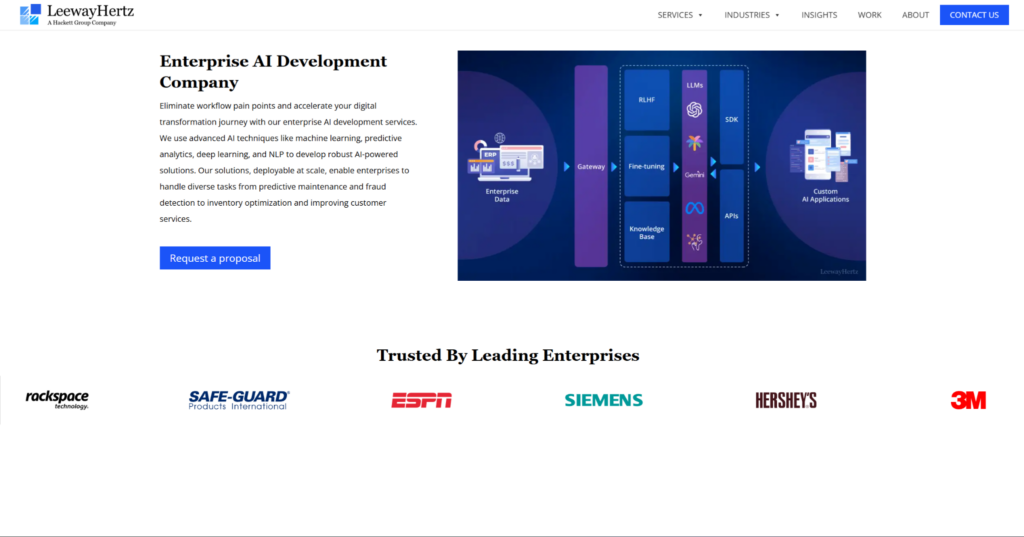
LeewayHertz works with enterprises that need custom AI systems, generative AI solutions, and AI agents connected with existing business infrastructure. The company has experience across AI, machine learning, deep learning, and NLP, which makes it relevant for projects that require more than a ready-made chatbot or a simple automation layer. Its work can include AI/ML consulting, generative AI development, enterprise AI development, and custom integrations.
The company’s AI agent and multi-agent development work is useful for businesses that need AI to support complex workflows across ERP, CRM, data warehouses, and internal systems. Instead of forcing companies to replace their current setup, LeewayHertz can build AI around existing tools and data flows. This is important for enterprises where the main challenge is not only building the model, but making it work with the systems teams already use.
Pros:
- Strong focus on custom AI systems, AI agents, and multi-agent workflows for enterprise use cases;
- Can connect AI with existing ERP, CRM, data warehouses, and internal business tools;
- Covers several project stages, from AI consulting and architecture to development and integration;
- Good fit for companies that need tailored AI builds rather than simple off-the-shelf automation.
Cons:
- Pricing is not public, so companies need a discovery call before estimating the budget;
- Broad AI positioning may require extra checks for highly regulated or niche industry projects;
- Public case studies do not always show clear ROI, timelines, or long-term performance after implementation.
One-line weakness: LeewayHertz has broad AI positioning, so companies in narrow sectors such as FSI or healthcare may need to check whether its vertical expertise is deep enough for their case.
3. Atlas Systems Pvt.
Founded in 2003, Atlas Systems works in sectors where AI has to respect strict data, vendor, and compliance rules. Its focus is not broad AI development for every possible use case. The company is closer to healthcare, BFSI, investment operations, provider data management, and third-party risk. That makes Atlas more suitable for projects where the data cannot be messy, ownership cannot be vague, and every process has to stand up to internal or external checks.
Atlas is not the type of vendor a company would pick for a quick AI feature or a generic automation tool. Its value is clearer when AI touches regulated workflows, sensitive records, vendor databases, financial controls, or operational risk. In those cases, the project has to work inside existing compliance structures instead of creating a separate layer that nobody can properly audit. Atlas is strongest when the company needs AI around data quality, risk, and regulated operations.
Key points:
- Works well for healthcare, BFSI, investment, and other compliance-heavy sectors;
- Focuses on provider data management, third-party risk, and regulated operational processes;
- More specialized than broad AI development firms, which helps when the project depends on auditability and data control;
- Has more than 20 years of experience with enterprise clients in complex industries;
- Public materials do not give much detail on AI rollout timelines, ROI, or exact project outcomes.
4. Addepto
Founded in 2018, Addepto builds custom AI, ML, and business intelligence solutions for companies with specific technical or operational problems. The company is not positioned as a vendor for generic AI tools. Its work usually starts with the client’s data, bottlenecks, goals, and the kind of system the business can actually use. That makes Addepto more suitable for cases where a ready-made product would be too limited or too hard to adapt.
Addepto works across computer vision, data engineering, data analytics, and generative AI development. This gives it room to handle projects such as defect detection in manufacturing, fraud analysis in finance, demand forecasting, document automation, or internal analytics tools. The company is strongest when the AI build needs serious data work behind it. It is a better choice for tailored systems than for simple plug-and-play automation.
Key points:
- Builds custom AI, ML, and BI solutions instead of relying on one fixed product model;
- Stronger for projects where the use case depends on specific data, processes, or industry context;
- Covers computer vision, data engineering, analytics, and generative AI development;
- Can help with practical use cases such as fraud analysis, defect detection, forecasting, and document automation;
- Pricing and project minimums are not clearly published, so budget checks require direct contact.
One-line weakness: Pricing structure and project minimums aren’t published—enterprises must request quotes, which slows initial evaluation.
5. RTS Labs
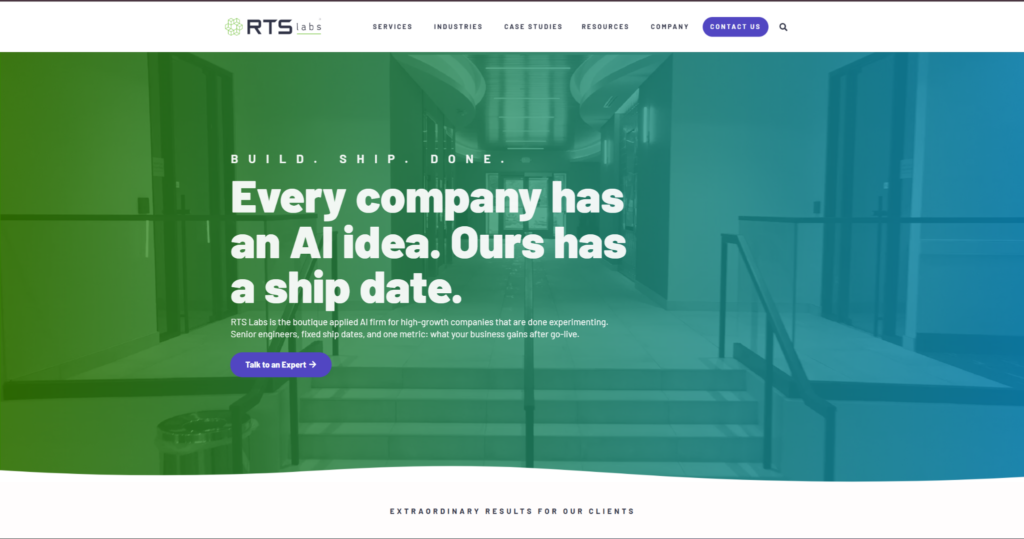
Founded in 2010, RTS Labs positions itself as the antidote to AI theater. Their tagline cuts through the noise: “Every company has an AI idea. Ours has a ship date.” This isn’t a consulting shop that leaves after the strategy deck—they build and operate AI agents, data engineering platforms, and generative AI solutions from concept through production operations. High-growth companies choose them when the pilot phase is over, and real business systems need to go live.
What sets them apart is accountability. Senior by design, they don’t hand off to junior teams after the sale. They own the post-launch performance. When an AI agent breaks at 2 AM or a data pipeline chokes on edge cases, they’re still there. That operational commitment separates implementation partners from advisory firms that vanish after the roadmap presentation.
Their focus on high-growth companies means they understand velocity and technical debt trade-offs. They build for scale, not demos. Worth it if you need production systems, not another feasibility study.
Pros:
- Accountable for post-launch performance and operations, not just delivery
- Senior practitioners who stay engaged through production scaling
- Ship-date culture eliminates pilot purgatory
Cons:
- No published vertical expertise in regulated sectors like FSI or healthcare
- Governance and compliance capabilities not documented for enterprise risk teams
One-line weakness: Sparse public case studies make it harder to validate their production track record before engagement.
6. Neurons Lab
Founded in 2019, Neurons Lab specializes in financial services and regulated environments where governance isn’t optional. They deliver custom AI agents and training programs designed for FSI compliance and governance, moving institutions from AI-curious to AI-enabled with systems that actually ship. Their embedded co-creation model means they work alongside your compliance, risk, and operations teams—not just PowerPoint strategists who disappear after the roadmap.
What sets them apart is accelerated pilot-to-production delivery with FSI domain expertise baked into every build. They understand that financial institutions can’t afford to experiment recklessly—every agent needs audit trails, explainability, and regulatory alignment from day one. Their training programs ensure your teams can operate and evolve the AI systems post-launch, not just inherit black boxes. This isn’t consulting theater. It’s engineering.
- Custom AI agents built for FSI compliance requirements
- Training programs designed for post-launch team enablement
- Embedded co-creation with risk and operations stakeholders
- Accelerated pilot-to-production delivery for regulated environments
- Limited public case studies or client references outside the financial services niche
Methodology
We compared these enterprise AI services companies by looking at what they can actually support inside a large organization. The main factors were data work, software engineering, system integration, industry experience, governance support, and help after the first release. We also looked at whether each company is clear about its services and whether its positioning fits enterprise projects rather than small experiments or pure advisory work. The ranking gives more weight to firms that can connect AI with existing tools, internal processes, data sources, and business teams.
Conclusion
Enterprise AI usually gets difficult after the first promising test. The real work starts when the system has to fit old software, strict access rules, messy data, security checks, and people who need to use it during normal work. That is where the choice of vendor matters. Some companies are stronger in custom development, some in regulated industries, some in automation, and others in long-term technical support.
Before choosing a partner, define the blocker clearly. One company may need better data foundations. Another may need engineering capacity. A third may need help with compliance, integrations, or internal adoption. Once the main problem is clear, compare only the vendors that match that need. The best partner is not the one with the loudest AI messaging, but the one that can make the system useful inside the business.